RayPoynter, 26 May 2026
AI only repeats what it was taught. That is a comforting line that appears whenever AI comes up in research conversations. AI is framed as an assistant, a parrot, a tool, a very fast intern with a big knowledge base and sometimes a flaky memory, but no imagination. The implication is reassuring, because it suggests the interesting thinking is still safely ours. But it is a myth,
This is the first post in a new series I am putting together on AI myths.
The counterexample: Aeneas
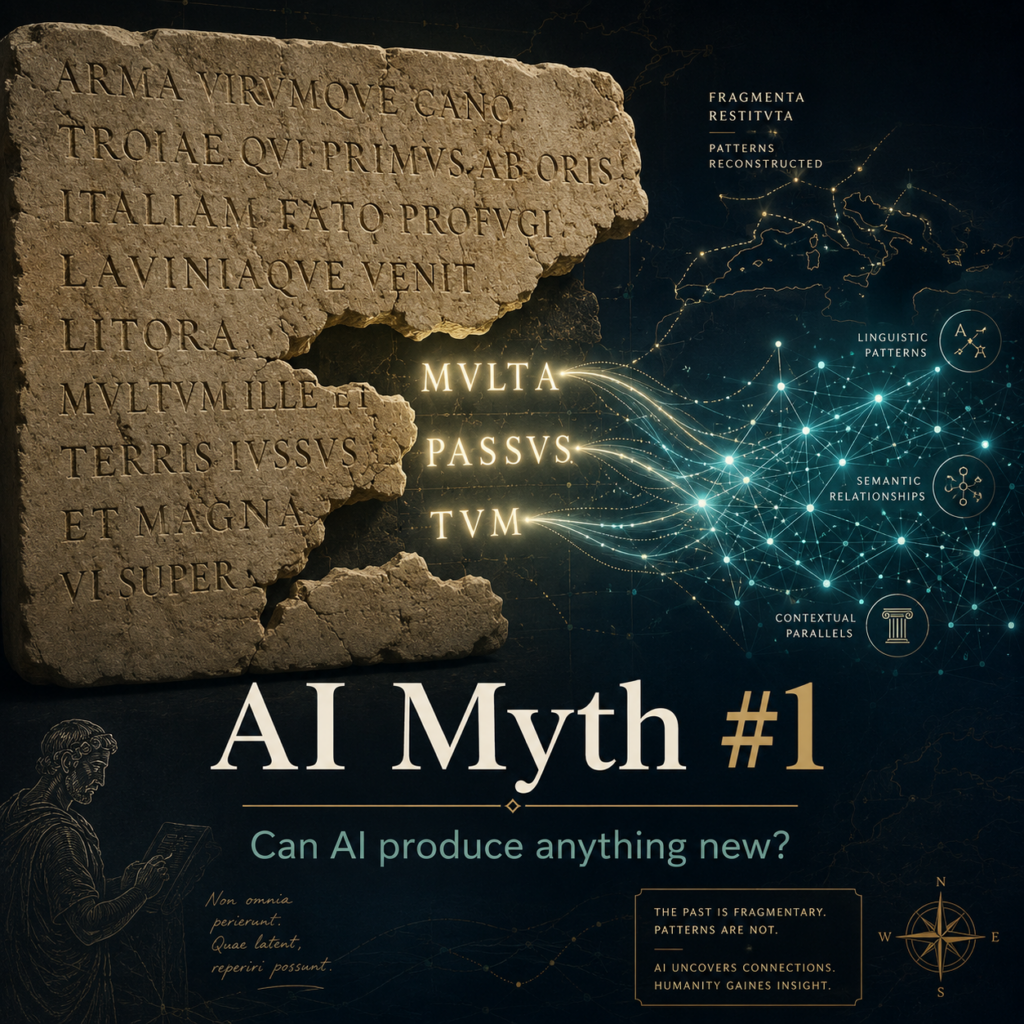
On 23 July 2025, a team from Google DeepMind, the University of Nottingham (my local university) and partners at the Universities of Warwick, Oxford and the Athens University of Economics and Business published a paper in Nature introducing a model called Aeneas. It is a generative model trained on a dataset of more than 176,000 Latin inscriptions, drawn from across the ancient Roman world. Its job is to help historians restore damaged texts and place inscriptions in time and space.
This is not a chatbot, and it is not a demo. It is a peer-reviewed piece of work, the code and dataset are open, and an interactive version is freely available to researchers, students and educators. That matters because it means the claims about what Aeneas can do are claims that other historians can check.
Why this case is awkward for the myth
Here is the part that bears directly on the “nothing new” claim.
Aeneas surfaced previously unidentified parallels between inscriptions. These were connections in wording, syntax, standardised formulas or provenance that the existing scholarship had not drawn. It reconstructed missing text that exists nowhere in its training corpus. It did this even in cases where the length of the gap itself was unknown, a capability the team calls arbitrary-length restoration. Filling a gap when you do not know how long the gap is cannot just be ‘retrieval’. There is nothing to retrieve. It is a genuine prediction about what an absent piece said.
At minimum, Aeneas is producing two kinds of new ‘things’. It is producing new connections, parallels that were latent in the corpus but unseen by scholars. And it is producing new reconstructions, proposed text that is not a copy of anything in the training data. Neither of those is a parrot repeating its lessons.
The validation
A model that proposes new claims is only interesting if the new claims are any good.
The team ran a study with 23 historians, testing their work both with and without the model. The experts judged the model’s outputs a useful starting point for further research in 90% of cases. More importantly, the combination of historian plus Aeneas outperformed either the historian alone or the model alone. The model also led to more accurate determinations of where and when inscriptions originated, dating them to within roughly 13 years and attributing geographic origin with around 72% accuracy.
That 90% figure is domain experts, looking at outputs in their own field, judging that the machine had given them something worth pursuing nine times out of ten.
What this actually shows, and what it does not
The blanket claim, that AI produces nothing new and only repeats what it was taught, does not withstand scrutiny in this case. Aeneas generated parallels and reconstructions that were not in its training data and were not previously known, and experts confirmed their value. What it does not show is that Aeneas invented anything from nothing.
What Aeneas is doing is finding what humans had not yet seen. The patterns and parallels were, in a sense, already present in the corpus. The model’s achievement is to make the latent visible. That is discovery.
The harder and more interesting question sits one step beyond that. Discovery is finding and identifying something new. Invention is creating something new and useful that was not latent in the existing material at all. Aeneas is a powerful demonstration of the first. Whether and where AI can do the second is, I believe, the live debate.
Why this matters for research and insights professionals
Be wary of the colleague who tells you, with a reassuring smile, that AI is just an assistant, capable only of doing what it was trained to do. It is a pleasant thing to believe, because it means the genuinely valuable work, spotting the pattern nobody else spotted, connecting the data points nobody else connected, stays firmly in human hands. The Aeneas case is a direct counterexample. Finding the parallel that the experts had missed is precisely the kind of work we tend to file under insight, and a model did it well enough that the experts agreed.
This does not make the historian redundant. The headline finding was that historian plus model beat either alone, and that is the realistic shape of the future for our field, too. But it does mean the line between human insight and machine assistance is not where the comforting story would place it. If your view of AI rests on the assumption that it cannot produce anything new, you are building on a myth, and you will be repeatedly surprised by people and competitors who are not building on that myth.
The open-access paper is available for anyone who wants to check the claims for themselves, which is exactly as it should be.
Source: Paper (open access): https://www.nature.com/articles/s41586-025-09292-5