Ray Poynter, 20 June 2026
Anthropic’s two most capable models disappeared for everyone in a single evening. For research teams now building on AI, that is a warning worth acting on.
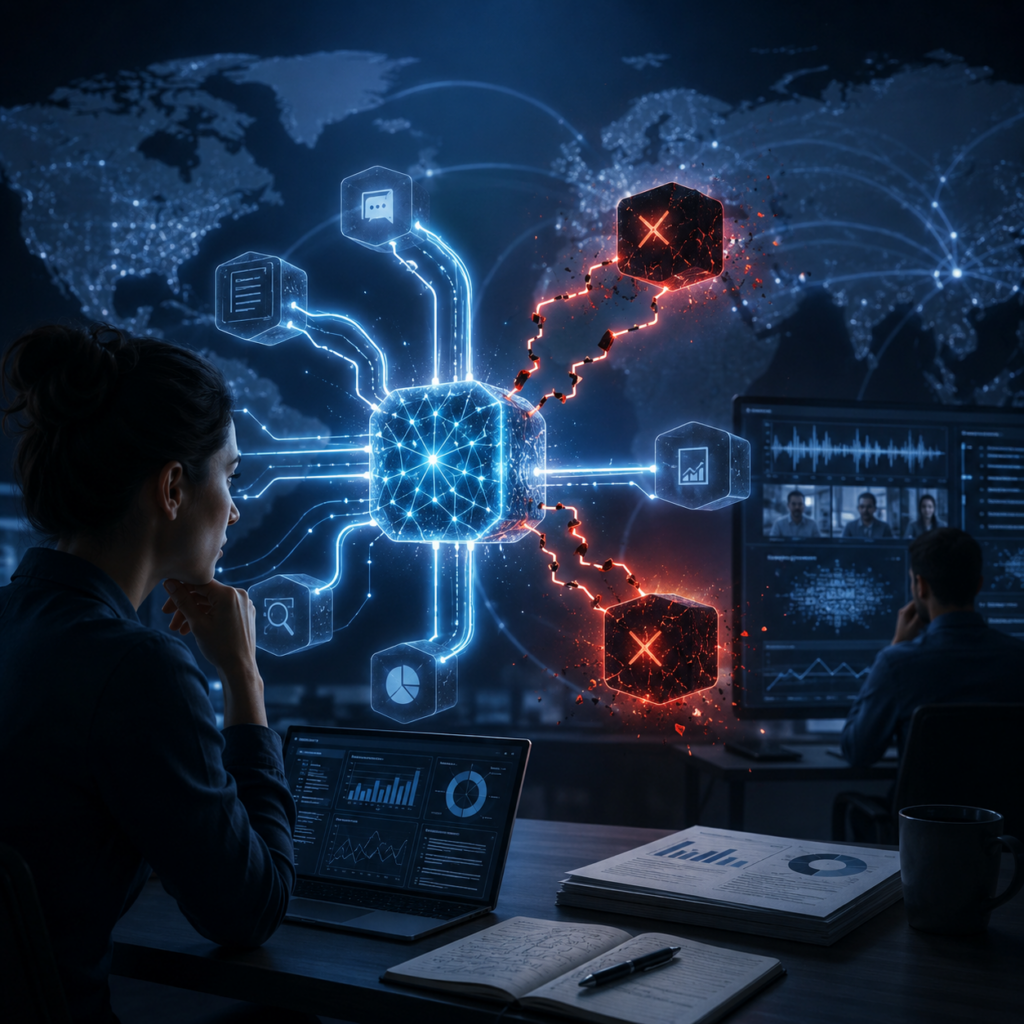
On the evening of 12 June 2026, the US government issued an export control directive, and within hours, Anthropic disabled its two most capable models (Fable 5 and Mythos 5) for every customer worldwide. The order arrived at 5:21 pm Eastern Time. By nightfall, the models were gone.
For our industry, this is more than a news item. Many research teams have integrated frontier models into their daily work: summarising depth-interview transcripts, coding open-ended responses, drafting reports, generating synthetic data, and increasingly running agents that carry out multi-step tasks. Anyone whose pipeline used Fable found it broken that evening, with no notice and no phased wind-down.
The dispute itself will probably be resolved. Anthropic calls the underlying concern narrow; cybersecurity experts have publicly questioned the decision, and both sides say they are working on a fix. It is tempting to treat this as an odd week in the AI news cycle. But I believe that this would be a mistake. The episode is a clear demonstration of two risks every insight team should now plan around.
Lesson one: build for the day the model disappears
The first lesson is about resilience. Any model your work depends on can be withdrawn at short notice, and the reasons sit largely outside your control. A regulatory order, a commercial decision by the provider, a security incident, or geopolitical developments could result in the removal of your service. Anthropic’s Fable showed how fast it can happen.
For researchers, this single point of failure is easy to overlook, because the model usually sits inside a tool, a plug-in, or a script rather than on an invoice you review each month. If your verbatim coding, your transcript analysis, or your synthetic-data generation all run through one provider, you have a dependency you may never have named. A few habits make the difference:
- Map your dependencies. Know which research tasks rely on which model, and rank them by how much disruption a sudden loss would cause.
- Stay provider-agnostic, so that swapping one model for another is a configuration change rather than a rebuild of your workflow.
- Keep a tested fallback. A second commercial provider helps, and an open-weight model you can host yourself helps even more, because it keeps working when an external supplier goes dark.
- Rehearse the switch. A fallback you have never run is only a hope.
Even the largest players are thinking this way. Microsoft is reported by Axios to be evaluating a self-hosted version of China’s DeepSeek as a lower-cost option for its Copilot Cowork agent, currently powered by Anthropic and OpenAI. When the firm that helped fund and distribute these LLMs is hedging its bets, smaller research businesses should take the hint.
Lesson two: if you sit outside the USA, read the small print
The second lesson is sharper for those of us outside the United States. Anthropic itself says around 80% of its consumer use is overseas. The detail worth noticing sits in the order: it did not ask Anthropic to switch the models off for the world. The stated intention was to bar foreign nationals from Fable and Mythos, whether outside or inside the US. This included Anthropic’s own non-citizen staff. The models went dark globally because separating users by nationality at that speed proved impractical. The worldwide blackout was a side effect. The original target was the non-US world.
For a research agency in the UK, Europe, or Asia, that distinction matters. When access to a frontier technology is restricted, you may be first in line to lose it.
This pattern in American technology policy predates the current administration. During the Second World War, the US drew on British research through the Manhattan Project. After the war, the Atomic Energy Act of 1946 cut the UK off from American nuclear knowledge until Britain built its own bomb, and cooperation resumed. For years, the US treated strong encryption as a munition and restricted its export, until the methods spread and the controls eased. The thread is consistent, the US restricts access to a frontier technology when it judges its lead to be at stake, and reliable access tends to return once others can stand on their own.
The day before the Fable directive, a group of Brussels analysts published “Europe 2031,” a speculative scenario picturing a continent hollowed out because it failed to build its own AI while the US and China raced ahead. It is worth reading with a sceptical eye, since it is deliberately alarmist and several of the US megaprojects it refers to have since wobbled. Yet one of its predictions, that Washington would one day restrict global access to advanced models, had briefly come true the very next day. A Spanish MEP, Nicolás Casares, drew the sober point in the Guardian’s coverage: the cutoff forces Europe to ask who is building its AI infrastructure and who benefits, since a region can end up funding capacity that others control and may, at times, decline to share.
What this means for us
For research businesses, the actions follow directly. Treat AI as critical infrastructure for your deliverables. Map where each dependency is hosted and which government can reach it. Keep a working fallback option. For example, open-weight models you can run yourself firmly in the mix. And assume that the most capable model you rely on today could be unavailable tomorrow.
There is a professional dimension too. As we fold AI into analysis, synthetic data, and reporting, continuity and reproducibility become quality questions, not only commercial ones. A method that quietly depends on a single supplier in a single jurisdiction can break for reasons unrelated to research.
The Fable models will most likely be switched back on. However, the key lesson will outlast this incident. Build as though any single model could disappear overnight, because one just did.