
Ray Poynter, 10 October 2026
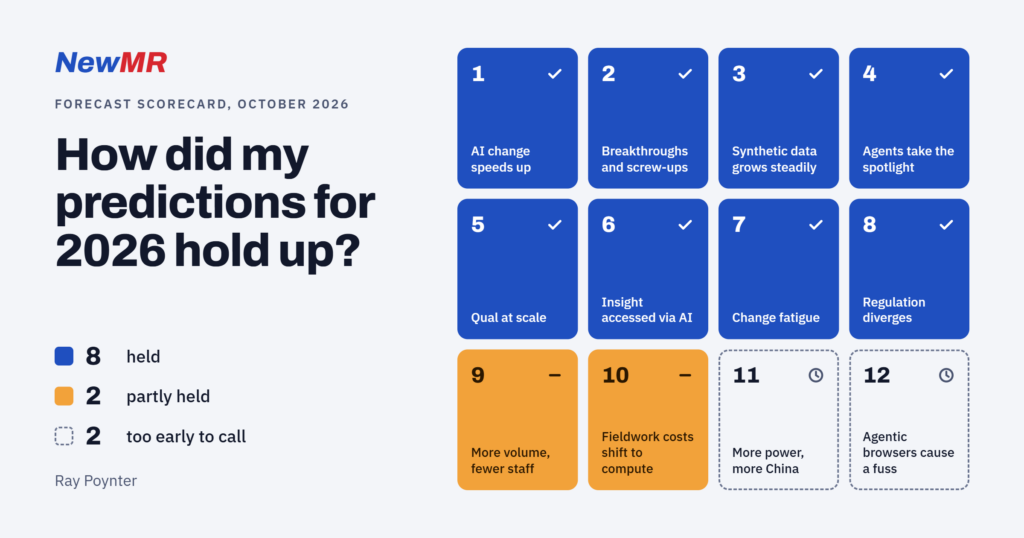
Last December I shared my forecasts for 2026 in a NewMR presentation, and in January I added a few more in Research Live’s preview of the year. With most of 2026 behind us, it seems only fair to mark my own homework. The short version is that most of my predictions have held, two have partly held, and a couple are still too early to call.
The predictions that have held
- The pace of AI change would increase, and the gap between leaders and laggards would widen. This is the clearest hit. The Esomar CEO Survey 2026 found 93% of agencies using AI and only 15% running it at scale. GRIT found brand-side analytics teams using agentic AI for 3.6 of seven tracked tasks, against 2.3 for brand-side research teams. Almost everyone has started, but very few have rebuilt how they work.
- There would be breakthroughs and screw-ups. Sadly, yes. On 3 September, several major AI services failed at almost the same time, and GWI found 55% of UK marketers say their business made a significant decision on AI-generated insight that later proved wrong.
- Synthetic data would grow steadily without displacing anything. Synthetic data moved from experiment to product line, with Simile raising over $200m and a wave of twin and persona launches. At the same time, the validation studies (Pew, Strat7, Ipsos with Stanford, Ipsos with Barilla) position it alongside human data. It works well on the predictable and struggles with the new, the emotional and the minority view.
- Agents and AI-powered solutions would take salience from general-purpose LLMs. The signature launch of 2026 was the Model Context Protocol (MCP), with at least ten research firms letting clients query their data from Claude, ChatGPT or Copilot. Qualtrics reported general-purpose AI use falling as AI embedded in research software rose.
- Qual at scale would arrive through AI moderation. The biggest valuations of the year went to AI interviewing, led by Salesforce’s reported $2bn deal for Listen Labs. MRII found 28% of researchers using AI to run interviews or ask open-ended questions.
- Deliverables would be built around AI and accessed via AI. I described AI as the new operating system for research. Clients can now interrogate research data from inside their AI assistants.
- Change fatigue would become a real issue. People are tiring of constant change, and the human side of AI is proving harder than the technology. One of the topics that comes up most often in my consultancy work is how hard it is to get people to adopt AI-based tools and keep using them once they have been rolled out. The surveys show the same strain: Qualtrics found 83% of research leaders say AI has made their teams more efficient, against just 65% of the people actually doing the work, and MRII found the motivation to learn new skills shifting from curiosity to pressure from employers.
- Regulation would diverge, and the economy would stay uncertain. California passed new privacy and AI laws that take effect on 1 January 2027, the EU-US data framework faces a fresh challenge, and UK marketers have now cut research budgets for six quarters in a row.
The predictions that have partly held
- Research volume would rise and headcount would fall. The volume half is happening. Research is faster, cheaper and increasingly delivered inside clients’ own AI tools, and Ipsos has committed to delivering a large share of its studies within 48 hours. The headcount half is mixed. GRIT recorded the first fall in brand-side research staffing in its tracked period, while 40% of MRII respondents say their company added jobs. What is clear is the anxiety: 63% of MRII respondents are concerned AI puts their job at risk, up from 40% in 2024. My biggest worry, that companies would freeze the hiring of new entrants, is now being echoed widely, including by Esomar’s AI Alliance.
- Costs would shift from fieldwork to compute. GRIT shows the largest service-led suppliers nearly doubling their use of synthetic data while the share relying on field services as a significant revenue source nearly halved. However, Ipsos found that a reliable digital twin can cost more per answer than a real respondent, so compute is a new cost line rather than a guaranteed saving.
Too early to call
- More power, more choice and more China. Models have certainly become more powerful, and open-weight models are now a serious option where data sensitivity or scale justifies them. The research industry evidence on Chinese models is still thin, so I am holding my verdict until 2027.
- Agentic browsers would cause a fuss. Agents are everywhere in research conversations, and browsers acting on our behalf are arriving in the wider tech world. They have yet to become a research issue, which I suspect will change once they start completing surveys.
What I underestimated
Scoring well on the technology is the easy part. What I underestimated was how quickly the conversation would move from capability to accountability.
- Accountability arrived faster than I expected. In many organisations ‘human in the loop’ has become ‘liability in the loop’: someone signs off output they did not design and cannot realistically check. The better standard, I believe, is ‘professional in the loop’, where experts design the workflow, check the evidence and own the advice.
- Quality became a wider issue. Only 33% of the 173 buyers in the GDQ study are confident poor respondents are removed before data reaches them. Meanwhile, the JMRA found only 8.2% of new panellists in Japan’s largest panels are still active a year later. Synthetic data needs human ground truth, so the health of our panels matters more than ever.
- The skills advice needed updating. In January I told new starters to focus on using AI. By the autumn, the skills that mattered most were verification, workflow design and supervising agents.
The lesson for me is that technology forecasts are easier than organisational ones. As this year’s GRIT report puts it, the operating model of insights moved first, before most leadership teams realised they had a decision to make.
Join me for the State of the Insights Nation
I’ll share the full picture, including the latest NewMR survey results and my predictions for 2027, in the State of the Insights Nation session. It opens the Festival of NewMR on Monday 16 November and is free to attend.
Register for the State of the Insights Nation
In the meantime, I would love to hear from you. Which of my 2026 predictions do you think I have scored too generously, and what did I miss?