
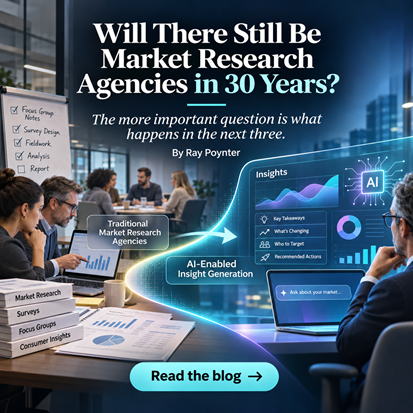
The More Important Question Is What Happens in the Next Three.
By Ray Poynter
Here’s a prediction. In 30 years, I think it is more likely than not that we won’t have market research agencies in anything like the form we recognise today. We will still need to understand people, markets and behaviour. Indeed, we might be doing vastly more research than we do today. But I struggle to imagine why organisations would need a separate industry sitting between the people who need answers and the information and people that can provide them.
This is not a certainty. Specialist organisations will probably still offer unique data, independent evaluation, expertise and other services. We may also see new kinds of intermediary emerge. But I suspect the traditional research agency will have been largely disintermediated.
However, this is not the prediction I think researchers should be worrying about right now. In three years, I expect to see plenty of research agencies and plenty of people employed as market researchers.
The important question is what happens between now and three years from now, and what the direction of travel will be over those three years and beyond.
In this post I set out my view of where AI is and where it is heading, review the history of disintermediation, challenge what we mean by market research, consider whether synthetic data is asking the wrong question, review why forecasts of doom might not happen quickly, and suggest some practical responses for the short term.
AI is going to get massively more powerful
Unless there is a global disaster, for example war, a major epidemic, a severe financial collapse or the impact of climate change, AI is going to keep getting more powerful and more agentic.
I expect that within the next few years AI will outperform most professionals on many of the individual tasks that currently make up white-collar work. That includes writing, analysis, prediction and creating outputs. It does not follow that AI will be better at delivering the entire job, including understanding the context, deciding what matters and securing action. But the direction of travel seems clear.
It will soon be better than humans at many tasks, including:
- Writing briefs, proposals, discussion guides and questionnaires.
- Analysing large, disparate and unstructured datasets.
- Making predictions from data.
- Solving well-defined problems.
- Creating compelling and insightful outputs, including reports, presentations and articles.
Where I think AI will lag humans in the near term includes:
- Distinguishing between what a stakeholder says they want and what they actually need.
- Understanding what level of detail and what sorts of ideas a stakeholder can use in making a business decision.
- Understanding what is knowable when working with responses from people about their own beliefs, motivations and plans.
- Leveraging personal knowledge and observations from the real world and real people.
- Convincing people to act in areas where the machines and the facts cannot do that work on their own.
- Working in fields where the written record is too small a subset of what is known. For example, decades of conducting qualitative research amongst non-Western or non-literate communities can provide knowledge that AI systems cannot readily reproduce.
The history of disintermediation
Over the last 30 years, we have watched technology transform intermediaries in travel, retail, finance, music, publishing and many other industries.
Travel agents haven’t completely disappeared, but the relationship between travellers, airlines, hotels and booking platforms is fundamentally different.
Sometimes disintermediation removes the intermediary. Sometimes it creates a new one. Booking.com and Expedia are examples of new intermediaries replacing some of the functions previously performed by traditional travel agents. The disappearance of today’s market research intermediaries could see the rise of different sorts of intermediary.
The challenge for market research agencies and suppliers such as panel companies is not necessarily irrelevance, but new alternatives. Organisations have questions and there are a growing range of sources of information that can help answer those questions. Increasingly, AI can connect the two.
Where does that leave the research agency? The answer depends on whether the agency provides something more useful than the alternatives.
Key point 1. Nobody owes us, the market research world, work simply because we have traditionally provided a particular service.
What is market research, anyway?
There are two ways I think about market research.
The first is that market research is a specialised discipline that helps organisations make better decisions by understanding people. We talk to people, observe them, listen to them, conduct experiments, use ethnography, examine behaviour, imagine possibilities and try to understand what makes people tick.
That need is not going to disappear, and perhaps this provides some reassurance.
The second definition is more challenging.
Market research is what you do when there’s no better way to get the answer.
Better might mean more accurate, quicker, cheaper, more useful or some combination of these.
If there is a better way to answer a business question, why would somebody commission conventional market research? Increasingly, AI and other technologies are creating new alternatives for specific problems. The industry does not have to be replaced all at once. It is more likely to be displaced one problem at a time.
We’ve changed our methods before, remarkably quickly
Think back to the transition from face-to-face and CATI to online research.
In the early 2000s, online research was still establishing itself. By the end of that decade, online data collection had become the leading individual quantitative method in many commercial research markets.
That was an extraordinary change in a relatively short period. It was not simply replacing an interviewer with a web browser. Much of the industry moved towards online access panels. These introduced different assumptions about sampling and representativeness from those associated, sometimes loosely, with probability-based approaches. The philosophical change from fresh samples to panels of pre-recruited people was arguably greater than many of the changes we are currently contemplating with AI.
Yet the industry made that transition because the practical advantages were compelling. As somebody who was involved in evaluating and promoting that change, I can confidently remind people that, in most cases, the data from online studies was not as good as the interviewer-administered surveys it replaced. Online was faster, cheaper and allowed new models to emerge.
I expect many AI-related changes will happen faster than the shift to online. Many of them do not require building new interview centres or recruiting large numbers of respondents. Much of the technology is software that can be adopted and improved almost immediately.
There are limits to this argument. Existing contracts, validation requirements and organisational inertia still matter. But we should remember how quickly the industry changed when online research became commercially attractive.
Synthetic data might be asking the wrong question
There is considerable excitement about synthetic respondents, digital twins and AI personas. But I wonder whether we are too attached to the idea of recreating the processes we already know.
Suppose AI becomes capable of accurately modelling how individuals or groups would respond to a product, advertisement or business proposition. Why then would we want to create a thousand synthetic respondents, give them a questionnaire, collect their answers, analyse those answers and then interpret what they mean?
Why wouldn’t we simply ask the AI system the business question directly and let it solve it, without processes like surveys or discussion guides?
If we want to know which product is likely to succeed, perhaps we should ask for a prediction, the supporting evidence, the uncertainty and the circumstances in which the prediction might be wrong, rather than create synthetic people for us to analyse.
Of course, this assumes that the underlying model is sufficiently accurate. That is a substantial requirement, and the question of how valid these AI systems are is still wide open.
My point is that synthetic respondents may be a transitional technology, partly designed around the methods researchers are familiar with, but essentially a dead end, even if it works.
Data collection has never been the whole profession
In the 1970s, research companies needed print rooms for questionnaires and punch rooms for processing data. Later, they needed telephone interviewing capabilities and CATI systems. Then they needed online survey software and access panels.
Today, we are discussing AI interviewers and synthetic respondents. For specialist data-collection businesses, these technologies are central to what they sell. For the broader insights profession, they are different ways of obtaining evidence.
Knowing where data come from, whether they are appropriate and what conclusions they support remains vital. But owning the mechanism used to collect them is not fundamental to being a market researcher. Replacing human respondents with synthetic respondents might transform the data-collection industry. It does not necessarily transform the purpose of research.
And perhaps the most important innovation will be discovering that we no longer need to collect certain types of data at all.
Key point 2. The value of market research lies in generating reliable understanding, rather than in owning or operating any particular method of data collection.
Possible doesn’t mean inevitable
Another important issue to consider is the difference between what is technologically possible and what will actually happen. A possible change does not automatically imply the change will happen quickly.
I will illustrate this point with an analogy. Imagine that tomorrow we had the technology to operate completely autonomous buses safely and reliably. Some would argue that we already have this.
Would every bus in the world immediately become driverless? Of course not. Indeed, it is hard to imagine that happening over just a few years.
There are approximately 20 million buses operating worldwide, while annual production is around 400,000. At that rate, manufacturing a completely new fleet equivalent to today’s would represent roughly 50 years of production. Of course, buses are continually replaced, production capacity can grow, and not every vehicle would need replacing immediately. Nevertheless, the scale of the existing fleet illustrates why technical feasibility does not automatically translate into rapid adoption.
The same principle applies to market research.
Imagine a multinational company running a brand tracker in 20 countries. It may have signed a three-year contract, with two years still to run. A radically better AI-based alternative might become available tomorrow.
But the company would need confidence that the new approach worked across its important markets, maintained adequate continuity, could be delivered reliably, and satisfied all the relevant legal, commercial and organisational requirements. A better method can exist for several years before switching becomes a realistic proposition.
So we need to distinguish three things:
- What technology can do.
- What makes economic sense.
- What organisations will actually adopt.
What should we do over the next three years?
I am deliberately looking 30 years into the future because I think it helps challenge our assumptions about what the industry is and why it exists.
But we cannot build a useful business strategy around predictions for 2056.
We can make much more practical choices about 2027, 2028 and 2029.
Over the next three years, I expect clients to increase their direct use of AI for tasks they previously commissioned agencies to perform. Research agencies will also automate more of their own workflows. These changes may initially improve agency margins rather than reduce agency revenues. But as clients recognise what is possible, the pressure on agency pricing, differentiation and business models will intensify.
I would suggest three starting points.
First, unlearn. Challenge the assumption that because we have always collected data, analysed it and presented a report in a particular way, that remains the best approach. Some of our established processes exist because of technological limitations that no longer apply.
Second, rethink. Start with what the client, the final stakeholder, needs to know and the decisions they need to make. Then identify the best way of helping them. Rather than beginning with the research services we would like to sell, let us think about what best answers the client’s needs.
Third, become AI-first. When designing a project or workflow, consider how you would solve the problem using the capabilities now available and those that are emerging. That may involve AI, existing data, experiments, conversations with people, conventional surveys or a combination of approaches.
I have seen some people say, or speculate, that they can differentiate themselves by not using AI. Frankly, I suspect that within three years many major clients will regard AI-based checking as a normal part of ensuring value for money and quality. Imagine a qualitative researcher who writes their own discussion guide, conducts the interviews personally and produces a report. The client may increasingly expect access to the transcripts, so that AI can compare the brief, the proposal, the evidence and the conclusions. The incremental cost of these checks can be very low, although confidentiality and accuracy still need to be managed. Whether or not researchers choose to use AI themselves, their work may increasingly be evaluated using it.
Key point 3. AI-first does not mean AI-only. It means avoiding an automatic preference for established methods.
For individuals, the challenge is to develop skills that remain valuable as tasks and workflows change. For agencies, it means examining which problems they can solve better than their competitors, including AI-based alternatives. For client-side teams, it means reconsidering how insight is generated and used throughout the organisation.
Looking five years ahead is useful for thinking about the kind of organisation we may need to become. But the changes required to reach that destination should start now.
Understanding change before judging it
None of this is a claim that every technological change is desirable.
Disintermediation can destroy livelihoods, concentrate power in technology platforms and create serious problems for customers and society. The growth in AI might be terrible for the climate.
AI can provide better answers, but it can also produce confident mistakes, reinforce existing biases and encourage organisations to act on unreliable information. We need to evaluate those consequences and make responsible choices.
Key point 4. Whether we like a particular change and whether it is likely to happen are different questions.
We should try to understand what is changing, consider the consequences and then decide how to respond. As I said earlier, the market research industry has no automatic right to survive in its existing form. Neither does any other industry.
Our opportunity is to remain valuable by providing the best solutions to enough important problems. That is what will matter over the next three years. And that is where I think our attention needs to be focused.
Join me at the Festival of NewMR
I’ll be exploring these ideas in my presentation, Rethinking Insights for an AI-First World, at the Festival of NewMR’s Innovation Day on Wednesday 18 November 2026.
I’ll be speaking in the APAC session, starting at 10:00 am Sydney time. If that is the middle of the night for you, sign up anyway and you can access the recording later.
We’ll consider the future of research agencies, AI capabilities, synthetic data, changing jobs and tasks, and the practical decisions researchers and insights organisations need to make over the next few years.
Register free via the NewMR event page: https://newmr.org/events/2026/innovation-day/
I hope you can join us.