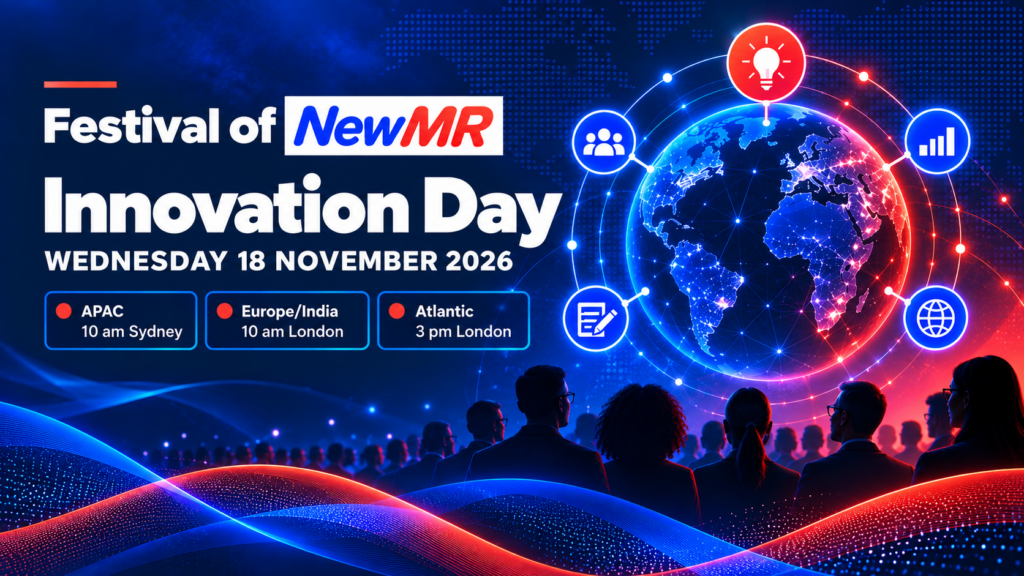
Wednesday 18 November 2026 · Festival of NewMR
Innovation Day
Three global sessions. New ideas, new methods and new possibilities for insights.
Innovation Day sits at the heart of the Festival of NewMR — a day dedicated to exploring what is changing in research and insights, what is becoming possible, and what leading practitioners are doing differently.
Across three sessions spanning APAC, Europe/India and the Atlantic, Innovation Day brought together researchers, innovators and industry leaders to share practical examples, emerging approaches and ideas that could shape what comes next.
Thank you to everyone who joined us on 18 November. The APAC recordings and most of the Europe/India recordings are ready to watch now on Play Again, and the rest will be there soon.
Date
Wednesday 18 November 2026
Sessions
Three global broadcasts
Recordings
Free to watch on Play Again
Watch the recordings
Each session was recorded, and all the talks are now on Play Again with the slides.
Programme
Ideas and innovation across three sessions
Explore the presentations from the day.
Session 1 · Wednesday 18 November
APAC
10:00 am Sydney
Rethinking Insights for an AI-First World

Co-founder, NewMR
AI is changing much more than the tools researchers use. It has the potential to reshape how organisations generate insight, the skills they need and even where the insights function sits. This session explores what happens as synthetic data, conversational analysis and increasingly end-to-end AI-enabled research become part of everyday practice.
What will researchers still do themselves? Which new capabilities will matter? How will hiring and team structures change? And as the boundaries between research, data, technology and decision-making shift, what might the insights function of the future look like?
Mental and Machine Availability: Putting System Zero to Work for Brand Growth

Founder, Sprout Strategy
System 1 and System 2 are deeply embedded in how we understand brands: what people instinctively feel and what they consciously consider. As AI shapes how brands are discovered, considered and chosen, System Zero adds a new dimension: how machines interpret, represent and recommend brands.
Elisa has spent the past 12 months conducting research, testing systems and working through how to bring System Zero into our brand tracking and wider research ecosystem, and putting it into practice, learning where the pitfalls sit and how this intelligence can help clients unlock new growth.
In this session, Elisa will share that experience and explore how to bring System Zero into your own research ecosystem. From measuring mental and machine availability together to identifying opportunities for growth, the focus is on practical application: what to measure, how to integrate it and how to turn the findings into action.
Session 2 · Wednesday 18 November
Europe / India
10:00 am London
Simulating Tomorrow for Coca-Cola’s Advanced Hydration Portfolio
Chief Innovation Officer, Human8
Coca-Cola’s global innovation programme for its Advanced Hydration portfolio (2027–2030) combined human insight, cultural foresight, creative methods and AI across six markets to build an innovation playbook with three strategic platforms, six big-bet concepts and a clear portfolio architecture.
To keep development consumer-centric, the team created Twin Communities — secure digital representations for ongoing engagement — and later Future Twin Communities to test how ideas evolve in future market conditions. Synthetic data did not replace research, but enabled capabilities that were previously impossible, strengthening both foresight and decision-making.
From Software Consumer to Software Creator: The New Reality of Market Research

Founder, Displayr
Before AI, market researchers spent much of their time working around their software: cutting, pasting, learning complex analysis tools, and spending days on tasks that should have been simple.
Now, AI can generate analyses, visualizations and even custom analytical tools in minutes. Instead of figuring out how to make their software do what they need, researchers can increasingly create what they want simply by describing it to AI.
But this raises an uncomfortable question. When anyone can produce a convincing-looking analysis or report in minutes, what makes professional research valuable?
The answer is surprisingly simple. Our job hasn’t changed. It’s always been to deliver results that people can trust. Not just answers that look right, but answers backed by sound methodology, rigorous analysis and evidence that can be checked.
What’s changing is how we do it.
6 Lessons for Building Trust in AI Simulations

Executive Director, Verve

Executive Director, Verve
Customer simulations are moving from isolated pilots to an embedded capability that informs high-stakes decisions at decision pace. After four years and 40+ global brands, we’ve seen this in practice: No7 Beauty Company teams ran over 250 consumer evaluations in a year, and HARMAN is expanding from JBL across brands and categories.
But scale only works if simulations can be trusted. This session shows how to establish and validate that trust, where simulations can and can’t be relied on, and how to keep them relevant as new questions emerge. We’ll also share the questions to ask whether you build in-house or work with a provider, plus lessons from embedding simulations in everyday workflows.
Beyond Demographics and OCEAN: Building AI Personas That Behave

Mass Cognition
Most AI personas are a demographic profile and a personality score wrapped in a prompt, closer to a horoscope than an AI representation of a consumer segment. They sound convincing but they drift toward the AI model’s default voice. This session sets out the basic principles of AI persona engineering: determining AI persona content, 3 ways AI personas can fail and testing AI personas: authenticity and behavioural fidelity. Finally there is a brief analysis of the advantages of AI personas vs Digital Twins.
Session 3 · Wednesday 18 November
Atlantic
3:00 pm London
Digital Twins: From Theory to Practice

Ipsos
David Priestley
Ipsos
The story of Ipsos’s journey to test the potential of digital twins in real-world research. We will explore how our collaboration with researchers at Stanford University, combined with extensive experimentation across a range of research tasks, has helped us understand where digital twins perform well, where their limitations lie, and what is required to use them reliably and responsibly.
Crumbs don’t lie: Using AI video analysis to understand snacking behaviour

NOVA at MMR Research Worldwide

CTI Senior Technologist, pladis Global
Generative AI has largely entered research through language: transcripts, open ends and conversations. But video opens another possibility. AI can observe behaviour.
Using a real pladis Global study of natural biscuit consumption, we explore what changes when AI moves from listening to consumers to watching what they actually do. Where does it add genuine research value? Where does it get things wrong? And what becomes more important, not less, about the researcher?
The Role of Emotion in Predictive Intelligence

Founder and CEO, Sentient Decision Science
AI can now beat humans at chess and Go and solve theorems that have stumped mathematicians for decades; however, those wins show the power of increased compute on logic-based problems, they do not show evidence of general intelligence.
Interestingly, the Insights industry finds itself in a position to make a significant impact on the development AGI through our work on Digital Twins. To make Digital Twin technology increasingly useful, we need to develop models that can generalize beyond context specific training, and the same is true for AGI. We provide case study evidence for the value of focusing on three areas within Digital Twin development: adding the unspoken, training on psychological mechanisms and validating against market outcomes, not survey responses.
The ultimate test of value for Digital Twins is the ability to accurately predict what people will do, especially in new situations. By incorporating emotional intelligence, Digital Twins become more generalizable, more valuable and possess the potential to be a better benchmark of our progress toward AGI.
Beyond the Pilot: Decision-Grade Customer Understanding at Decision Pace

Executive Director, Verve
Customer simulations are moving from isolated pilots to an embedded capability that informs high-stakes decisions at decision pace. After four years and 40+ global brands, we’ve seen this in practice: No7 Beauty Company teams ran over 250 consumer evaluations in a year, and HARMAN is expanding from JBL across brands and categories.
But scale only works if simulations can be trusted. This session shows how to establish and validate that trust, where simulations can and can’t be relied on, and how to keep them relevant as new questions emerge. We’ll also share the questions to ask whether you build in-house or work with a provider, plus lessons from embedding simulations in everyday workflows.
Innovation Day is part of the Festival of NewMR
The Festival brings together researchers, insight professionals, clients, innovators and future-focused thinkers from around the world for ideas, learning and conversations about the future of insights and research.
Explore the full Festival programme