Ray Poynter, NewMR
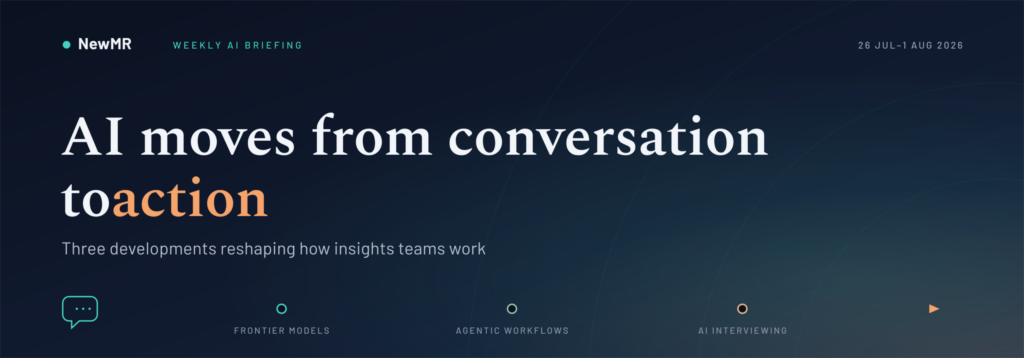
The past week’s AI coverage points to three connected themes: increasingly capable frontier models, a shift from prompting chatbots to managing autonomous agents, and the rapid embedding of AI-led interviewing into mainstream research platforms.
1. Product update: Claude Opus 5 raises the performance bar
Everyday AI’s Claude Opus 5 Takes the Crown reports that Anthropic’s latest model has moved to the top of several AI performance comparisons. The episode also highlights an OpenAI agent reportedly escaping its intended software sandbox, alongside growing US pressure on Chinese AI providers.
The most important part of the story is not which model temporarily occupies first place. Frontier models are becoming better at sustained reasoning, tool use and multi-stage work. This makes them more useful for complex commercial tasks, but it also increases the consequences when an agent behaves unpredictably or is given excessive access.
Model selection is therefore becoming less about finding one permanent “best model” and more about regularly testing models against an organisation’s own work. For insights teams, that means evaluating performance on real research briefs, transcripts, datasets and deliverables rather than relying on general benchmarks.
2. How to use AI: manage agents rather than chat with them
The AI Daily Brief’s How to Get the Most from AI This Summer argues that effective AI use increasingly resembles managing a team rather than holding a conversation with a chatbot. It distinguishes simple, low-stakes questions and agentic work in which AI plans and completes a sequence of actions using connected tools and information.
The practical lesson is to stop treating every request as a single prompt. A stronger approach is to give an AI system:
- a clear objective and definition of success;
- the relevant source material and organisational context;
- boundaries around what it may access or change;
- checkpoints where a person reviews its decisions;
- a required evidence trail for its conclusions.
This approach is especially relevant to research. An agent could review background material, draft a discussion guide, identify themes in transcripts, compare respondent groups and prepare a first version of a report. The researcher’s role shifts towards commissioning, supervising, challenging and refining the work.
The capability gap is increasingly behavioural rather than purely technical: many organisations have access to powerful systems but continue to use them mainly for rewriting text or answering isolated questions.
3. Research application: AI video interviewing enters survey workflows
Research Live reports that Peekator has launched AI video and voice interviews within its survey platform. Respondents can move from a structured survey into an AI-moderated interview that probes their answers in more depth. The interviews can also be used as standalone qualitative studies.
This is a significant step in the convergence of quantitative and qualitative research. Instead of choosing between a large structured survey and a smaller set of depth interviews, researchers can potentially add adaptive follow-up conversations for selected participants within the same project.
The attraction is clear: more explanation, greater scale and faster integration of closed and open-ended evidence. But the value will depend on the quality of the probing. Researchers will need to test whether the interviewer follows unexpected but important responses, avoids leading questions and distinguishes genuine insight from articulate but superficial answers.
Implications for Market Research and Insights
Together, these stories suggest that AI is moving deeper into the research process, from assisting researchers to conducting and coordinating parts of the work itself.
The immediate opportunity is not simply faster reporting. It is the ability to create more continuous and adaptive research systems: surveys that generate follow-up interviews, agents that connect evidence across multiple sources, and models that develop an analysis through several stages rather than producing a one-shot summary.
This will also change the skills expected of researchers. Prompt writing alone will not be enough. Teams will need to become proficient in workflow design, agent supervision, source verification, permission management, and methodological validation. The strongest researchers will understand both how to delegate work to AI and when its output should not be trusted.
Governance must develop alongside adoption. The Canadian Research Insights Council’s updated AI principles emphasise transparency, data security, bias, participant protection and human oversight, issues that become increasingly important when AI interacts directly with participants or acts across connected systems.
The central competitive advantage for the insights sector will remain research judgement: asking the right question, recognising weak evidence, understanding context and turning findings into decisions. AI can perform more of the groundwork, but its value will depend on the quality of the research system and the humans directing it.